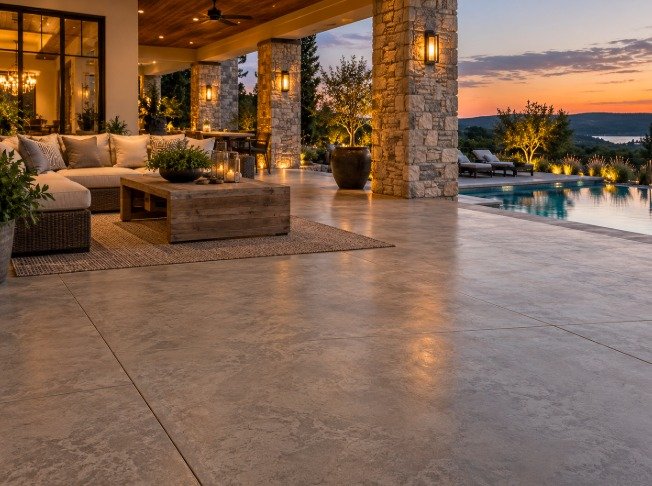
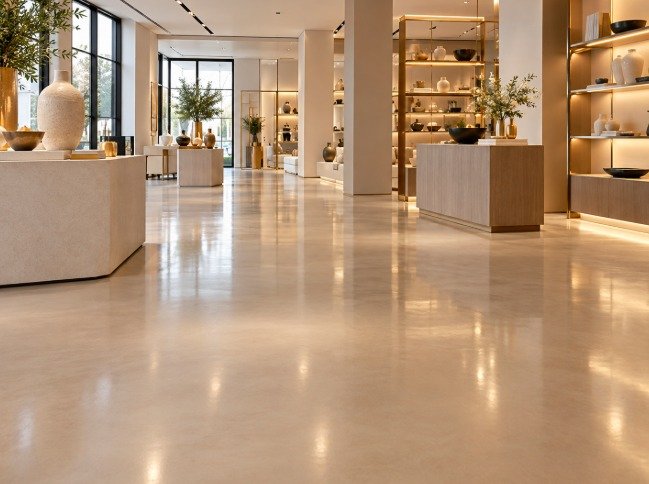
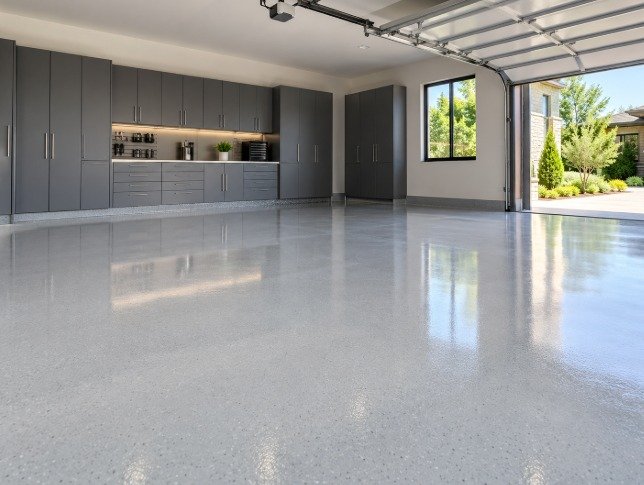
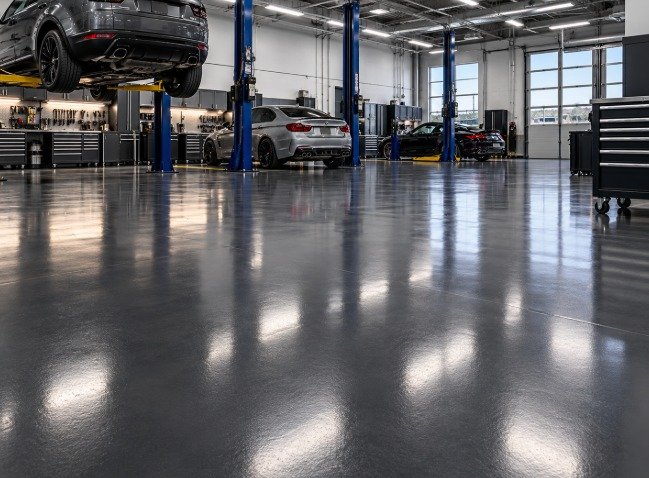
Concrete floor coatings are designed to improve the appearance, durability, cleanliness, and overall performance of concrete surfaces. Whether the floor is located in a garage, basement, workshop, warehouse, retail store, commercial building, or industrial facility, a properly selected coating system can help protect the concrete while creating a more finished and easier-to-maintain surface.
Concrete coatings are available in many different systems, including epoxy, polyaspartic, polyurethane, clear sealers, decorative flakes, metallic finishes, and high-performance commercial coatings. The best option depends on how the space is used, the condition of the concrete, moisture levels, traffic, chemical exposure, and the desired appearance.
A successful coating project begins with proper surface preparation and a system designed for the specific environment.
Concrete Epoxy Coating
Epoxy is one of the most widely used concrete floor coating systems. It can create a strong bond to properly prepared concrete and is available in decorative and functional finishes.
Epoxy coatings may be used in:
Garages
Basements
Workshops
Retail stores
Commercial facilities
Warehouses
Showrooms
Utility rooms
Industrial areas
Epoxy can be installed as a solid-color coating, decorative flake system, metallic floor, or part of a multi-layer flooring system.
Where Can Concrete Floor Coatings Be Installed?
Concrete coating systems can be considered for many spaces, including:
Garages
Basements
Workshops
Warehouses
Retail stores
Offices
Showrooms
Salons
Auto shops
Manufacturing facilities
Utility rooms
Gyms
Commercial buildings
The right system depends on how the floor will be used and the condition of the concrete.
Polyaspartic Concrete Coatings
Polyaspartic coatings are known for fast curing and can be used in certain residential and commercial floor systems.
They are commonly used as:
Base coats
Flake system coatings
Protective topcoats
Polyaspartic products are popular in garage flooring systems and other applications where quicker curing may be beneficial.
Basement concrete can be coated to create a cleaner and more finished space.
Coatings may be used in:
Finished basements
Home gyms
Workshops
Storage rooms
Recreation areas
Laundry rooms
Basements should be evaluated for moisture before installation because below-grade slabs can have different moisture conditions than above-grade floors.
Residential Concrete Floor Coatings
Residential concrete coating systems can be used throughout the home where concrete surfaces are present.
Common locations include:
Garages
Basements
Workshops
Laundry rooms
Home gyms
Utility spaces
Mudrooms
Homeowners can choose from solid colors, decorative flakes, metallic patterns, textured finishes, and clear coatings.
Solid-color coatings provide a clean and uniform appearance.
Popular colors include:
Gray
Charcoal
Tan
Beige
Black
White
Blue
Custom colors
Solid-color systems are commonly used in garages, commercial spaces, workshops, warehouses, and utility areas.
Anti-Slip Concrete Floor Coatings
Some locations need additional surface traction. Slip-resistant additives can be added to certain coating systems to create more texture.
Anti-slip coatings may be useful in:
Garages
Workshops
Commercial kitchens
Auto shops
Entry areas
Warehouses
Wet environments
The amount of texture should be balanced with cleaning requirements.
Chemical Resistant Concrete Coatings
Some floors are regularly exposed to oils, cleaners, automotive fluids, chemicals, and other substances. Chemical-resistant coatings may provide better protection than untreated concrete.
These systems are often used in:
Auto repair shops
Laboratories
Manufacturing facilities
Commercial kitchens
Maintenance rooms
Industrial buildings
Chemical resistance varies by coating type, so the expected exposure should be considered during product selection.
Garages and automotive spaces often deal with oil and fluid spills. A coated floor can make cleanup easier than bare concrete, which is porous and can absorb contaminants.
Oil-resistant systems may be appropriate for:
Residential garages
Mechanic shops
Car dealerships
Service centers
Workshops
Spills should still be cleaned as soon as possible.
High-Traffic Concrete Floor Coatings
Busy commercial and industrial environments need coatings designed for repeated use. High-traffic floor systems may include thicker layers and stronger topcoats.
They may be used in:
Retail stores
Warehouses
Schools
Gyms
Commercial garages
Manufacturing spaces
The system should be selected according to pedestrian, cart, forklift, or vehicle traffic.
Our Concrete Floor Coating Process
1
Free Estimate & Floor Assessment
We visit the property, measure the space and discuss how it is used, the look you want and your timeline.
2
Concrete Inspection & Moisture Testing
We check for cracks, joints, old coatings, paint, oil contamination and moisture to choose the right system.
3
System Recommendation
We recommend the best option: sealer, polish, epoxy, polyaspartic, flake, metallic or a heavy-duty system.
4
Coating Removal & Grinding
Old paint and coatings are removed, and the slab is diamond-ground or shot blasted to the correct profile.
5
Repairs, Joints & Leveling
Cracks, joints, spalls and low areas are repaired, and high spots are ground for a uniform surface.
6
Primer or Moisture Barrier
A primer, or a moisture-mitigating barrier when needed, is applied for a strong bond to the concrete.
7
Coating, Finish & Topcoat
We install the base coat and color, flakes or metallic layer, then the protective topcoat in your chosen sheen.
8
Cure Time & Final Walkthrough
We inspect the finished floor with you, explain when it can be used and provide maintenance guidance.
Concrete Floor Grinding
Concrete grinding is one of the most important preparation methods used before installing a floor coating.
Diamond grinding removes contaminants, old coatings, surface irregularities, and weak concrete while creating a profile that allows the new coating to bond properly.
Grinding may be used to remove:
Old paint
Previous epoxy
Adhesive residue
Light surface damage
Contamination
Uneven coating layers
Mechanical preparation is usually more reliable than simply cleaning or acid washing the surface.
Concrete Surface Profiling
Surface profiling creates the texture needed for a coating to bond to the concrete.
Mechanical grinding or blasting opens the surface and removes contaminants.
The required profile varies depending on the coating system.
Proper profiling is a critical step in professional floor installation.
Concrete Crack Repair
Concrete cracks should be evaluated before a coating system is installed. Small cracks can often be cleaned, prepared, and filled before the new coating is applied.
Common repairs may include:
Hairline crack repair
Larger crack filling
Surface patching
Edge repair
Joint repair
It is important to understand that concrete naturally expands, contracts, and moves. Some cracks may return over time even after repair.
The purpose of the repair is to create the best possible surface for the new coating.
Concrete Joint Repair
Expansion joints, control joints, and damaged floor joints can affect the appearance and performance of a finished coating.
Joint repair may involve cleaning, filling, rebuilding damaged edges, or leaving certain joints functional depending on the slab design.
Not every joint should be permanently filled, so the condition and purpose of the joint should be considered before treatment.
Concrete Moisture Testing
Moisture is an important factor in concrete floor coating projects.
Concrete may allow vapor to move upward through the slab, especially in basements, garages, older buildings, and below-grade spaces.
Excessive moisture can interfere with the bond between the concrete and coating.
Moisture testing may help determine whether the floor is suitable for a standard coating system or whether a specialized moisture-control product is needed.
Concrete Moisture Barrier
When moisture vapor is a concern, a moisture-mitigating primer or barrier system may be recommended. These products are designed to help control vapor transmission before the decorative or protective coating is installed.
The exact solution depends on moisture test results, slab condition, and product specifications.
Moisture barriers are commonly considered for:
Basements
Older garages
Commercial buildings
Warehouses
Below-grade spaces
Concrete Floor Leveling
Uneven concrete can create problems with both appearance and coating performance. Concrete floor leveling may be needed to correct low areas, surface irregularities, or certain transitions.
Depending on the situation, leveling may involve:
Grinding high spots
Patching low areas
Applying compatible leveling material
Rebuilding damaged sections
The goal is to create a more uniform surface before the coating system is installed.
Concrete Floor Resurfacing
Older concrete does not always need complete replacement. Concrete floor resurfacing can help restore worn, rough, or damaged surfaces before a new coating is applied.
Resurfacing may include:
Grinding worn concrete
Removing weak surface material
Patching damaged areas
Filling cracks
Correcting small imperfections
Removing previous coatings
Preparing the floor for a new finish
The condition of the slab should be evaluated before resurfacing begins.
Concrete Coating Removal
Before installing a new coating, an existing failed or incompatible coating may need to be removed.
Removal methods may include:
Diamond grinding
Mechanical scraping
Shot blasting
Other professional surface preparation methods
The goal is to expose a stable surface suitable for the new system.
Old Paint Removal
Painted concrete floors can present adhesion problems if the existing paint is weak or peeling.
Old paint should usually be removed before installing a professional coating system.
This helps reduce the risk that the new coating will fail because the old layer underneath loses adhesion.
Concrete Floor Coating Repair
Existing floor coatings can sometimes be repaired when damage is limited.
Possible repairs may include:
Chip repair
Scratch repair
Localized patching
Topcoat renewal
Crack repair
Partial recoating
If the coating is failing across large areas, complete removal and replacement may provide a better long-term solution.
Concrete Floor Coating Cost in Los Angeles
Concrete floor coatings are priced per square foot based on the system, the condition of the slab and the preparation required. The ranges below are typical for Los Angeles projects and include standard grinding and cleaning.
Price by coating system
System
Per sq. ft.
Clear Concrete Sealer
$1.50 – $3
Concrete Polishing
$3 – $8
Solid Color Epoxy
$4 – $7
Flake Coating System
$5 – $9
Polyaspartic System
$7 – $12
Industrial High-Build
$6 – $12
Metallic Epoxy
$8 – $14
Preparation & repair add-ons
Service
Price
Old Coating or Paint Removal
$1.50 – $3 / sq. ft.
Moisture Barrier Primer
$2 – $4 / sq. ft.
Crack Repair
$5 – $15 / linear ft.
Joint Repair
$6 – $15 / linear ft.
Floor Leveling
Quoted per area
What Affects the Price
Total square footage
Coating system and number of layers
Condition of the concrete
Removal of paint or old coatings
Crack, joint and leveling work
Moisture test results
Indoor or outdoor (UV) exposure
Anti-slip, chemical-resistant or decorative options
Prices are estimates only. Larger areas often cost less per square foot, and your final price depends on the space, concrete condition, repairs needed and the system you choose. Every project gets a free estimate and a written quote before work begins.
Both are excellent, and many of our floors use both. Epoxy bonds strongly to prepared concrete, builds thickness well and is the base for flake and metallic designs. Polyaspartic cures much faster and is more UV-stable, so it is often used as a topcoat or for one-day garage floors. We recommend a system after looking at your concrete, sun exposure, traffic and how quickly you need the space back.
A sealer is a thin, often clear product that soaks into or sits on the concrete to help resist stains and moisture while keeping a natural look. A coating, such as epoxy or polyaspartic, builds a thicker protective layer that can add color, flakes or metallic effects. Polishing uses grinding machines to refine the concrete itself into a smooth, shiny surface without applying a coating. Each suits different spaces and budgets.
Diamond grinding mechanically removes weak surface concrete, old sealers, paint and contamination, and creates a consistent profile the coating can grip. Acid etching only cleans the surface lightly, can leave residue behind and does not remove coatings or oil. Mechanical preparation is more reliable and is one of the most important reasons professionally installed coatings last longer than do-it-yourself kits.
Usually the old paint or failing coating needs to be removed first. If a new coating is applied over weak or peeling paint, it can only be as strong as the layer underneath it. We grind or shot blast the floor down to sound concrete, then install the new system. In some cases, a well-bonded existing epoxy can be prepared and recoated, and we'll check this during your estimate.
Moisture vapor rising through a slab is a common cause of coating bubbles and peeling, especially in basements, older garages and below-grade spaces. We can test the concrete before installation. If moisture levels are high, we may recommend a moisture-mitigating primer or barrier under the coating, or a different flooring system. Active leaks or standing water must be fixed before any coating is installed.
Upgrade Your Concrete with a Professional Floor Coating
Concrete floor coatings can transform a plain, stained, or worn slab into a cleaner, more attractive, and more functional surface.
Whether you need a simple solid-color coating, decorative flake system, metallic finish, chemical-resistant floor, or high-traffic commercial system, the coating should be selected according to the specific demands of the property.
Proper preparation is just as important as the coating itself. Grinding, crack repair, moisture evaluation, and surface profiling all help create the foundation for a successful installation.
With the right materials and professional application, concrete floor coatings can provide an attractive and durable upgrade for residential, commercial, and industrial spaces.