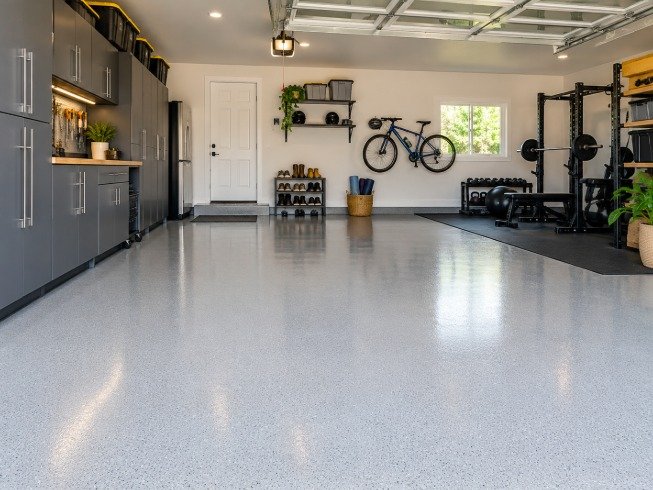
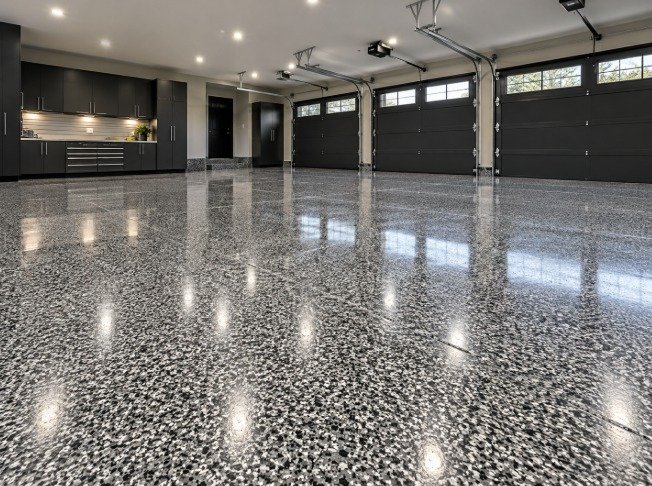
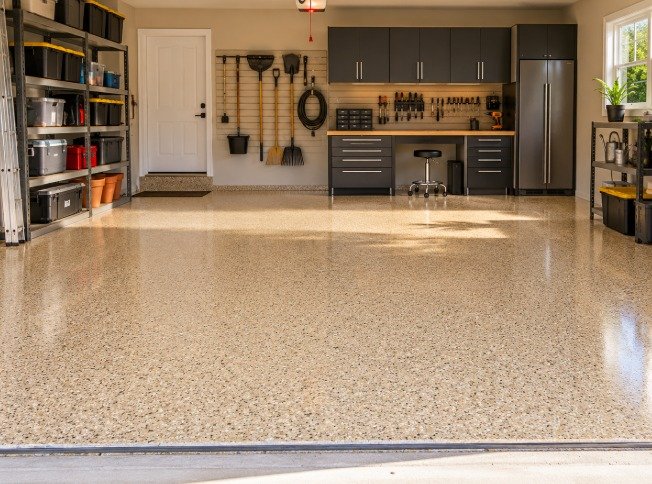
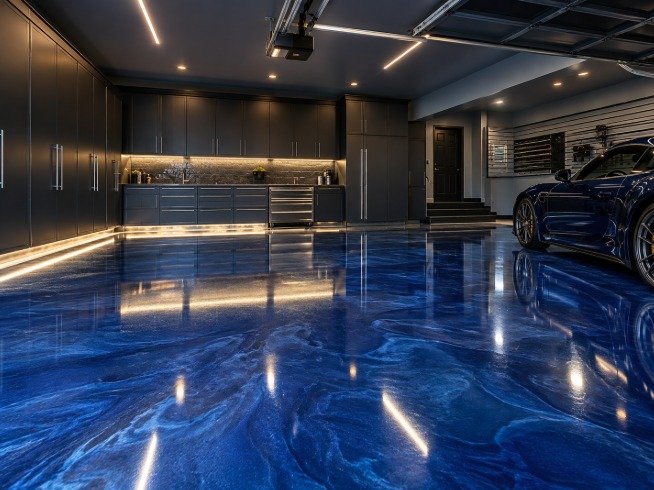
A garage floor takes more abuse than almost any other surface in a home. Vehicle traffic, hot tires, oil, tools, moisture, dirt, chemicals, and daily foot traffic can quickly leave untreated concrete stained, cracked, dusty, and difficult to clean. Professional garage epoxy flooring creates a cleaner, stronger, and more attractive surface while helping protect the concrete underneath.
We install garage epoxy flooring systems for homeowners who want to improve both the appearance and performance of their garages. Whether you are coating a new garage floor, resurfacing older concrete, repairing damaged areas, or upgrading to a decorative flake or metallic finish, the system should be selected and installed according to the condition of the slab and the way the garage is used.
Garage Epoxy Floor Installation
Professional garage epoxy floor installation starts with proper concrete preparation. Applying epoxy over dirty, smooth, damaged, or contaminated concrete can lead to poor adhesion and premature failure.
The installation process may include concrete cleaning, diamond grinding, crack repair, joint treatment, surface profiling, primer application, epoxy coating, decorative broadcast material, and a protective topcoat.
Every garage is different. New concrete may need only preparation and coating, while an older floor may require repairs, resurfacing, or removal of an existing coating before installation can begin.
A properly installed epoxy floor provides a seamless surface that is easier to maintain and can dramatically improve the overall appearance of the garage.
Garage Floor Coating
Garage floor coating systems can transform plain gray concrete into a finished surface designed for daily use. Depending on the project, homeowners can choose from solid-color coatings, decorative flakes, metallic finishes, textured systems, and high-performance topcoats.
A garage floor coating can help reduce concrete dust, improve stain resistance, make cleaning easier, and provide a more finished appearance.
The right coating system depends on several factors, including:
Condition of the concrete
Amount of vehicle traffic
Exposure to moisture
Desired appearance
Need for slip resistance
Chemical exposure
Garage size
Existing cracks or damage
Rather than treating every floor the same, the coating system should match the needs of the property.
Residential garage epoxy flooring is ideal for homeowners who want to upgrade an unfinished or worn garage.
Epoxy can be installed in attached garages, detached garages, workshops, home gyms, storage garages, hobby spaces, and multi-purpose garages.
Many homeowners use their garages for much more than parking. A professionally coated floor can make the space feel cleaner and more comfortable for projects, storage, exercise, hobbies, or entertaining.
Residential garage epoxy is available in many styles, making it possible to coordinate the floor with cabinetry, wall colors, vehicles, or the overall design of the home.
Two-car garages are among the most common residential epoxy flooring projects. A two-car garage usually needs enough durability to withstand daily vehicle traffic while still providing a clean and attractive finish. Decorative flake systems are especially popular because they help hide small amounts of dust and debris while providing visual texture.
Before coating a two-car garage, the concrete should be inspected for cracks, surface damage, oil contamination, moisture concerns, and previous coatings. Proper preparation creates the foundation for a longer-lasting finish. Homeowners can choose from subtle neutral colors, darker industrial-style tones, decorative chip blends, or custom color combinations.
Three-Car Garage Epoxy Flooring
Three-car garages require careful planning because of their larger surface area and heavier potential use. These spaces may hold multiple vehicles, motorcycles, tools, storage systems, workbenches, recreational equipment, and other items. The flooring system should provide consistent coverage throughout the entire garage.
Three-car garage epoxy flooring can include decorative flakes, anti-slip texture, high-performance topcoats, and customized color combinations. Large garages also benefit from professional surface preparation because inconsistencies in the concrete are more noticeable across a wider area. The goal is to create a uniform floor that performs well throughout the entire space.
Garage Floor Flake System
Garage floor flake systems are one of the most popular choices for residential garages.
Decorative vinyl flakes are broadcast into the coating while it is still wet. After the coating cures, excess flakes are removed and the surface is sealed with a protective topcoat.
Flake systems provide a decorative appearance while also helping disguise small amounts of dust, dirt, and surface imperfections.
Homeowners can choose from many flake combinations, including:
Gray blends
Black and white blends
Tan blends
Blue blends
Brown blends
Custom color combinations
Flake density can also be adjusted. Some homeowners prefer a light decorative broadcast, while others choose a full-broadcast system that provides heavier coverage.
Metallic garage epoxy offers a more dramatic and customized appearance.
Metallic pigments are blended into the coating to create flowing patterns, movement, depth, and color variation. The final result can resemble marble, stone, clouds, waves, or other abstract designs. No two metallic floors look exactly alike.
Metallic epoxy is a popular option for luxury garages, collector-car garages, show garages, home workshops, and homeowners looking for something different from traditional garage coatings.
Possible color combinations include silver, charcoal, black, copper, blue, white, gold, bronze, and custom blends.
Because metallic coatings create a distinctive visual pattern, installation technique plays an important role in the final appearance.
Solid-color epoxy provides a clean, simple, and uniform appearance. This option works well for homeowners who prefer a minimal look without decorative flakes or metallic effects.
Popular solid colors include:
Light gray
Medium gray
Charcoal
Tan
Beige
White
Black
Blue
Custom colors
Solid-color floors can work well in garages used for parking, workshops, home gyms, storage areas, and hobby spaces. A protective topcoat can also be added to improve durability and make routine maintenance easier.
Anti-Slip Garage Flooring
Garage floors can become slippery when exposed to water, automotive fluids, rain, or cleaning products. Anti-slip garage flooring uses texture or traction additives to help improve grip.
Slip-resistant systems may be especially useful in:
Garages with sloped floors
Wet climates
Workshops
Home gyms
Entry areas
Garages connected to pools
High-traffic spaces
The amount of texture can be adjusted depending on the project. Too much texture can make cleaning more difficult, while too little may not provide enough traction. The goal is to create a practical balance between slip resistance and easy maintenance.
Oil & Chemical Resistant Garage Floors
Garages are frequently exposed to automotive fluids, oils, cleaners, gasoline residue, chemicals, and other contaminants. A properly selected epoxy flooring system can provide better resistance to many common garage substances than bare concrete.
Bare concrete is porous and can absorb spills quickly. Once oil or other liquids soak into the slab, stains and odors may become difficult to remove.
A coated floor creates a less porous surface, allowing many spills to be wiped up before they penetrate the concrete.
For garages used for automotive work, workshops, or frequent vehicle maintenance, a chemical-resistant coating system may be recommended. Resistance varies depending on the specific coating and substance, so the flooring system should be selected according to the expected use of the garage.
We visit your garage, measure the space, discuss how you use it and show you color, flake and metallic samples.
2
Concrete Inspection & Moisture Testing
We check the slab for cracks, oil contamination, old coatings and moisture so we choose the right system.
3
Diamond Grinding & Cleaning
The concrete is ground to open the surface and create the right profile, then vacuumed and cleaned.
4
Crack, Joint & Surface Repair
Cracks, chips, spalling, holes and damaged joints are filled and ground flush for a smooth, stable base.
5
Primer & Base Coat
A penetrating primer and a thick base coat are applied to bond tightly with the prepared concrete.
6
Flakes, Metallic or Color
We broadcast decorative flakes, work in metallic pigments or apply your solid color, then scrape and clean excess flake.
7
Protective Topcoat
A durable clear topcoat seals the floor, with optional anti-slip texture and your choice of gloss level.
8
Cure Time & Final Walkthrough
We review the finished floor with you, explain cure times and maintenance, and make sure you're completely satisfied.
Garage Epoxy Floor Preparation
Surface preparation is one of the most important steps in any garage flooring project. Concrete that is too smooth or contaminated may prevent the coating from bonding correctly.
Professional preparation may include diamond grinding or another mechanical process designed to open the concrete surface and create the proper profile.
Skipping proper preparation can significantly reduce the performance of the coating.
Not every garage floor is ready for epoxy immediately. Older concrete may have surface wear, rough areas, minor deterioration, previous repairs, or uneven patches. Garage floor resurfacing can help restore the surface before the new coating system is installed.
Resurfacing may involve:
Grinding damaged concrete
Removing old coatings
Repairing surface defects
Filling cracks
Leveling low areas
Treating worn sections
Preparing the slab for proper coating adhesion
The exact process depends on the condition of the concrete. Resurfacing is especially important when the existing garage floor has years of wear but is still structurally suitable for a new coating system.
Garage Floor Repair
Cracks, chips, spalling, and damaged joints should be addressed before installing epoxy. Garage floor repair can improve the appearance of the finished coating and help create a more stable surface.
Common repairs include:
Concrete crack repair
Small hole repair
Surface patching
Spalled concrete repair
Joint repair
Edge repair
Low spot correction
Damaged coating removal
Repair methods depend on the type and severity of the damage. It is important to understand that concrete can naturally move over time, so some cracks may return even after repair. However, proper preparation and repair can significantly improve the overall quality of the finished floor.
Garage Epoxy Flooring Cost in Los Angeles
Garage epoxy flooring is priced by square foot and by the coating system you choose. The ranges below are typical for Los Angeles garages and include standard surface preparation.
Price by garage size (flake system)
Garage size
Approx. area
Estimated cost
1-Car Garage
about 250 sq. ft.
$1,300 – $2,300
2-Car Garage
about 450 sq. ft.
$2,300 – $4,000
3-Car Garage
about 650 sq. ft.
$3,300 – $5,800
Price by coating system
System
Per sq. ft.
Solid Color Epoxy
$4 – $7
Flake Epoxy System
$5 – $9
Polyaspartic Coating
$7 – $12
Metallic Epoxy
$8 – $14
What Affects the Price
Size of the garage
Condition of the concrete
Crack, joint and surface repairs
Removal of old coatings
Moisture treatment if needed
Flake density or metallic design
Anti-slip texture and topcoat choice
Prices are estimates only. Your final price depends on floor size, concrete condition, repairs needed and the finish you choose. Every garage gets a free on-site estimate and a written quote before work begins.
Garage epoxy flooring offers a combination of appearance, durability, and easier maintenance.
Benefits may include:
Cleaner finished appearance
Reduced concrete dust
Easier sweeping and cleaning
Improved resistance to staining
Decorative color options
Custom flake systems
Metallic designs
Slip-resistant finishes
Improved surface durability
Protection for the concrete underneath
Epoxy flooring can also make the garage feel like a finished part of the home rather than an unfinished storage area.
Custom Garage Flooring Options
Every homeowner has different goals for their garage. Some want a simple gray floor that is easy to clean. Others want a decorative flake system that coordinates with cabinets and storage systems. Car enthusiasts may prefer a high-gloss metallic floor that creates a showroom appearance.
Garage flooring can be customized through combinations of:
Base colors
Flake colors
Flake density
Metallic pigments
Surface texture
Gloss level
Anti-slip additives
Protective topcoats
A customized system allows the finished floor to match both the appearance and functional needs of the garage.
One of the advantages of epoxy flooring is that routine maintenance is relatively simple.
Loose dirt can usually be removed with a broom, dust mop, or vacuum. For deeper cleaning, the floor can be washed using suitable cleaning products and water.
Spills should be cleaned promptly, especially automotive fluids or chemicals.
Avoid dragging sharp metal objects directly across the floor, and use protective pads under heavy equipment or machinery when appropriate.
Regular cleaning helps preserve both the appearance and performance of the coating.
Most two-car garages are completed in one to three days. The first day usually covers grinding, crack repair and the base coat, followed by the flake or color layer and a protective topcoat. You can typically walk on the floor after about 24 hours and park vehicles after about 72 hours. Timing depends on the coating system, the condition of the concrete and the temperature in the garage.
Hot tire pickup usually happens when a coating is applied over poorly prepared concrete or when a thin, low-quality product is used. We diamond-grind the slab so the coating bonds into the concrete, then use high-performance base coats and topcoats rated for vehicle traffic. With proper preparation and a full coating system, your floor is built to handle daily parking, turning tires and the heat of a car pulling in after a drive.
Yes, in most cases. Cracks, chips and spalled areas are repaired before coating, and oil stains are degreased and ground away during preparation. Some deeply soaked stains may need extra treatment. Because concrete naturally moves over time, some cracks can return even after repair, but proper repair and preparation greatly improve the appearance and performance of the finished garage floor.
It depends on how you use the garage and the look you want. Flake systems are the most popular because they hide dust and small imperfections and add light texture. Metallic epoxy creates a dramatic, showroom-style finish for collector and luxury garages. Solid color gives a clean, simple look for parking, workshops and home gyms. During your free estimate we'll show samples and recommend the best fit.
Sweep, dust-mop or vacuum loose dirt regularly, and wash the floor with water and a suitable pH-neutral cleaner when needed. Wipe up oil, gasoline and chemical spills promptly. Avoid dragging sharp metal objects across the surface, and place protective pads under jack stands, heavy equipment and motorcycle kickstands. With this simple routine, your garage floor will keep its shine and protection for years.
Upgrade Your Garage with Professional Epoxy Flooring
Whether your garage floor is new, stained, cracked, worn, or simply unfinished, epoxy flooring can provide a dramatic upgrade. From basic residential garages to large three-car spaces, workshops, collector garages, and high-end show garages, there are coating systems available for many different applications.
Our garage epoxy flooring services include installation, resurfacing, concrete repair, decorative flake systems, metallic epoxy, solid-color floors, anti-slip finishes, and oil- and chemical-resistant flooring.
A successful garage floor starts with good preparation, proper materials, and careful installation. With the right system, your garage can become cleaner, more attractive, easier to maintain, and better suited for everyday use.