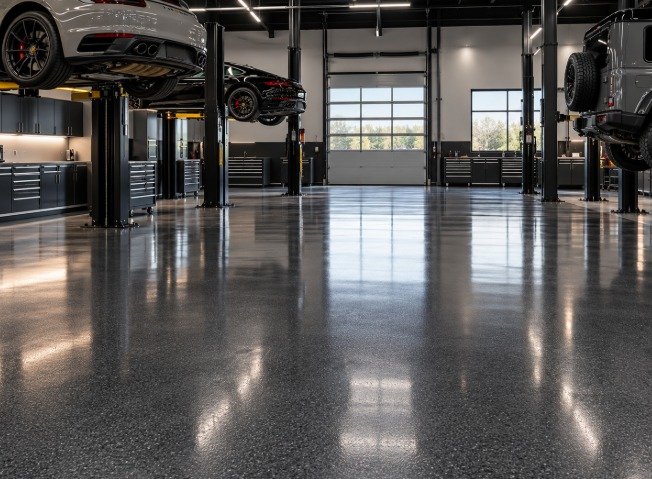
Polyaspartic flooring is a high-performance concrete coating system known for fast curing, strong durability, attractive finishes, and excellent versatility. It is commonly used in garages, workshops, commercial spaces, warehouses, showrooms, retail environments, and other areas where property owners want a durable coating with a quicker return to service than many traditional floor systems.
Polyaspartic coatings can be installed as solid-color floors, decorative flake systems, clear protective topcoats, or part of a multi-layer floor system. They are especially popular for garage flooring because they can provide strong abrasion resistance, good chemical resistance, and improved UV stability compared with many standard epoxy coatings.
The best results depend on proper concrete preparation, correct product selection, and professional installation.
Polyaspartic Floor Coating
A polyaspartic floor coating is a resin-based system that bonds to properly prepared concrete and creates a tough protective surface.
Polyaspartic coatings can be used as:
Primer layers
Base coats
Decorative flake coats
Clear topcoats
Full flooring systems
They are available in different colors and finishes and can be customized according to the needs of the property.
Because polyaspartic materials cure relatively quickly, installation must be carefully managed to ensure proper coverage and adhesion.
Fast-Cure Floor Coatings
One of the main advantages of polyaspartic flooring is its relatively fast curing time.
Depending on the product and conditions, a polyaspartic system may allow the space to return to service faster than many conventional epoxy systems.
This can be especially useful for:
Busy garages
Retail spaces
Commercial buildings
Service areas
Businesses that cannot close for long periods
Cure times vary based on temperature, humidity, product specifications, and system thickness.
Where Can Polyaspartic Flooring Be Installed?
Polyaspartic coatings can be used in many locations, including:
Garages
Workshops
Basements
Utility rooms
Retail spaces
Showrooms
Commercial garages
Warehouses
Service centers
Auto shops
Commercial buildings
The correct system should always be selected according to the conditions of the space.
Garage Polyaspartic Flooring
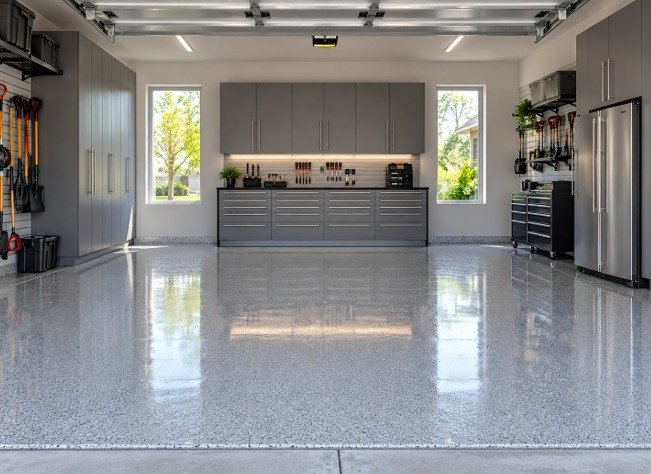
Garages are one of the most common applications for polyaspartic flooring.
Garage floors are exposed to:
Vehicle traffic
Hot tires
Oil
Automotive fluids
Dirt
Moisture
Tools
Heavy storage
A polyaspartic system can help protect the concrete while creating a cleaner and more finished appearance.
Garage polyaspartic flooring is available in solid colors, decorative flakes, and custom blends.
Polyaspartic flooring can also be used in other residential spaces with concrete floors.
Possible applications include:
Basements
Workshops
Laundry rooms
Home gyms
Utility rooms
Mudrooms
Storage areas
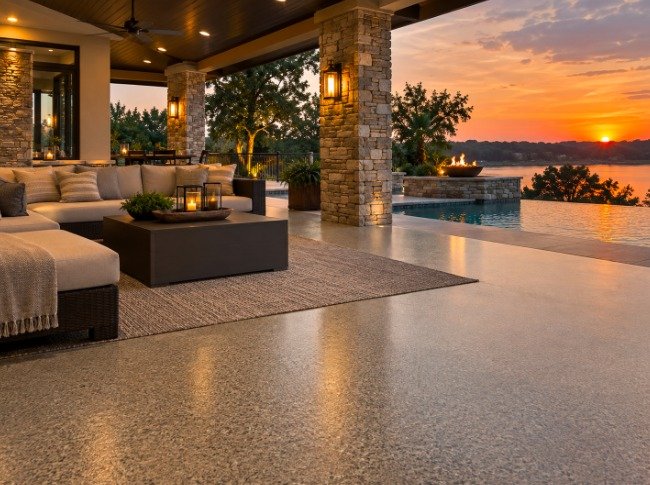
Covered patios
The system should be selected based on whether the space is indoors or exposed to sunlight, moisture, or changing temperatures.
UV-Resistant Floor Coatings
Polyaspartic coatings are often selected for their improved resistance to UV exposure compared with standard epoxy. Some epoxy systems may yellow or discolor when exposed to sunlight for long periods. Polyaspartic topcoats can provide better color stability in locations exposed to natural light.
This makes them useful for:
Garages with open doors
Showrooms
Entry areas
Certain covered outdoor spaces
Commercial buildings with large windows
The exact UV performance depends on the specific product.
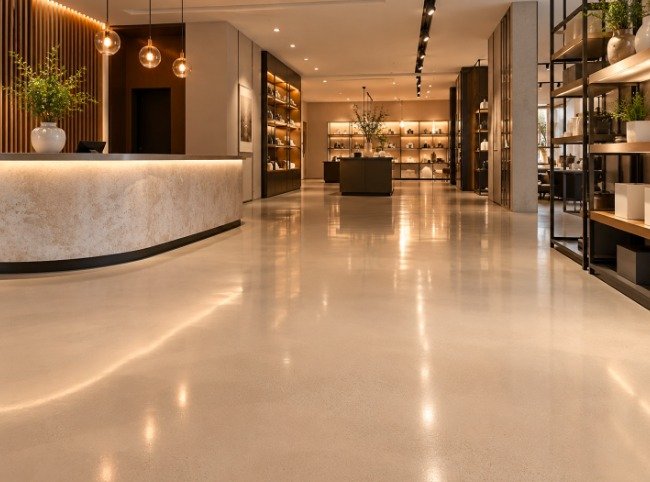
Commercial Polyaspartic Flooring
Commercial properties often need floors that can handle frequent foot traffic and daily operations.
Polyaspartic coatings may be used in:
Retail stores
Offices
Showrooms
Salons
Auto dealerships
Service areas
Gyms
Commercial garages
The coating can be customized with slip-resistant texture and decorative finishes.
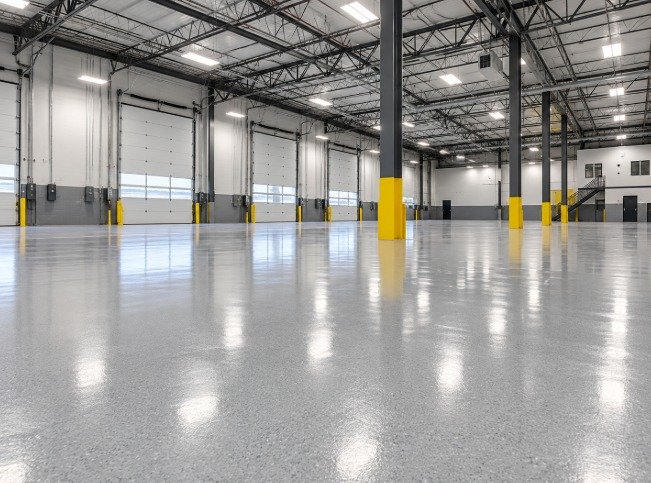
Certain industrial spaces can use polyaspartic flooring when rapid curing and durability are important.
Applications may include:
Warehouses
Manufacturing areas
Maintenance rooms
Loading areas
Equipment spaces
Commercial workshops
The exact system should be selected according to traffic, chemical exposure, and operating conditions.
High-Traffic Polyaspartic Floors
Polyaspartic coatings can be used in high-traffic environments when the flooring system is designed for the expected load.
Applications may include:
Retail stores
Commercial garages
Warehouses
Showrooms
Service facilities
Workshops
The system should account for whether traffic consists of pedestrians, vehicles, carts, or equipment.
Polyaspartic Flake Flooring
Decorative flake flooring is one of the most popular polyaspartic systems.
A base coat is applied to the prepared concrete, decorative flakes are broadcast into the wet material, and the surface is sealed with a clear protective topcoat.
Flake systems can provide:
Decorative color variation
Added visual texture
Easier maintenance
Custom color options
Slip-resistant finishes
They are commonly used in garages, commercial spaces, workshops, and utility areas.
Full broadcast systems use enough decorative flakes to completely cover the wet base coat. Once cured, excess flakes are removed and the floor is sealed.
This creates a dense decorative finish and can help hide small amounts of dust and debris between cleanings.
Popular color blends include:
Gray, black, and white
Tan and brown
Blue and gray
Charcoal and black
Custom blends
Partial Flake Polyaspartic Flooring
Partial flake systems use a lighter amount of decorative chips. This allows more of the base coat color to remain visible.
A partial broadcast can create a simpler decorative appearance while still adding texture and visual interest.
Polyaspartic Garage Floor Colors
Garage systems can be customized with many color combinations.
Popular options include:
Light gray
Medium gray
Charcoal
Tan
Beige
Blue-gray
Black and white blends
Custom decorative flakes
Color can be coordinated with cabinets, walls, storage systems, and vehicles.
Solid Color Polyaspartic Flooring
Solid-color polyaspartic floors provide a clean and uniform appearance.
Popular colors may include:
Gray
Charcoal
Tan
Beige
White
Black
Blue
Solid-color systems work well in garages, workshops, utility areas, and commercial spaces.
Polyaspartic Topcoat
Polyaspartic coatings are frequently used as clear protective topcoats over epoxy or decorative flake systems. The topcoat provides the final walking or driving surface.
A polyaspartic topcoat can help provide:
Abrasion resistance
Chemical resistance
UV stability
Gloss retention
Protection for decorative flakes
It can also be customized with anti-slip additives when additional traction is needed.
Clear Polyaspartic Coatings
Clear polyaspartic coatings can be used over decorative floors or certain concrete surfaces.
Clear coatings can help protect:
Decorative flakes
Epoxy base coats
Custom designs
Colored systems
They may be available in gloss, satin, or other finish levels depending on the product.
Gloss Polyaspartic Flooring
Gloss finishes create a bright and polished appearance.
They are popular in:
Garages
Showrooms
Retail areas
Commercial spaces
Gloss coatings can also help enhance decorative flake colors.
Satin Polyaspartic Flooring
Satin finishes create a softer sheen and may be preferred in spaces where a high-gloss look is not desired.
The finish still provides a clean and professional appearance.
Oil Resistant Polyaspartic Flooring
Vehicle fluids can quickly stain untreated concrete. A properly installed polyaspartic system creates a less porous surface, making it easier to clean many common automotive spills before they penetrate the slab.
This makes polyaspartic flooring popular in:
Residential garages
Auto shops
Dealerships
Workshops
Service centers
Chemical Resistant Polyaspartic Flooring
Garages, workshops, and commercial spaces are often exposed to oils, cleaners, automotive fluids, and chemicals. Polyaspartic systems can provide resistance to many common substances.
Chemical resistance varies between products, so the coating should be selected based on the expected exposure. Spills should still be cleaned promptly.
Anti-Slip Polyaspartic Flooring
Smooth coatings can become slippery when wet. Anti-slip additives can be incorporated into the topcoat to increase surface texture.
Slip-resistant polyaspartic flooring may be useful in:
Garages
Workshops
Entryways
Commercial spaces
Service areas
Areas exposed to moisture
The amount of texture should be balanced with cleaning requirements.
Benefits of Polyaspartic Flooring
Polyaspartic flooring can offer several advantages depending on the system. Potential benefits include:
Fast curing
Faster return to service
Good abrasion resistance
Improved UV stability
Decorative flake options
Solid-color options
Chemical-resistant systems
Anti-slip finishes
Easier routine maintenance
Residential and commercial applications
Polyaspartic Flooring vs Epoxy Flooring
Polyaspartic and epoxy flooring both have advantages.
Epoxy may offer:
Excellent adhesion
Thick build options
Metallic design possibilities
Versatile decorative finishes
Polyaspartic may offer:
Faster curing
Better UV stability
Strong abrasion resistance
Faster return to service
Many professional systems use both materials together—for example, an epoxy base coat with a polyaspartic topcoat.
The right system depends on the property and project goals.
Polyaspartic Flooring vs Polyurea
Polyaspartic and polyurea coatings are related but are not identical.
Both can cure quickly and offer strong performance.
Polyaspartic coatings generally provide more working time than some fast-curing polyurea materials, which can make installation easier in certain applications.
Product specifications vary, so the flooring system should be selected based on the project rather than the product name alone.
Cracks should be evaluated and repaired before coating whenever possible.
Common repair work may include:
Crack filling
Joint repair
Surface patching
Spall repair
Edge repair
Concrete can continue to move over time, so some cracks may return even after repair.
Moisture Evaluation
Concrete moisture can affect the performance of flooring systems.
Garages, basements, and older slabs may have higher moisture vapor levels.
Testing may be recommended before installation.
Depending on the conditions, a moisture-control primer may be needed before the polyaspartic layers are applied.
Polyaspartic Floor Resurfacing
Older concrete may need resurfacing before the new floor system is installed.
Resurfacing may include:
Grinding damaged areas
Removing failed coatings
Repairing surface defects
Filling cracks
Leveling low spots
The goal is to create a sound substrate for the new coating.
Polyaspartic Floor Repair
Existing polyaspartic floors can sometimes be repaired if the damage is localized.
Possible repairs include:
Scratch repair
Chip repair
Localized recoating
Crack repair
Topcoat renewal
If a large area is failing, full removal and replacement may be more appropriate.
Polyaspartic Flooring Cost in Los Angeles
Polyaspartic flooring is priced per square foot based on the system, the number of coats, the condition of the concrete and the finish. The ranges below are typical for Los Angeles projects and include standard surface preparation.
Price by polyaspartic system
System
Per sq. ft.
Epoxy Base + Polyaspartic Topcoat
$6 – $10
Solid Color Polyaspartic
$6 – $9
Full Broadcast Polyaspartic Flake
$7 – $12
Commercial / Industrial Polyaspartic
$7 – $12
Clear Topcoat Recoat
$2 – $4
Typical polyaspartic garage floors
Garage size
Approx. area
Estimated cost
1-Car Garage
about 250 sq. ft.
$1,750 – $3,000
2-Car Garage
about 450 sq. ft.
$3,150 – $5,400
3-Car Garage
about 650 sq. ft.
$4,550 – $7,800
What Affects the Price
Size of the space
Condition of the concrete
Crack, joint and surface repairs
Removal of old coatings
Moisture-control primer if needed
Full polyaspartic or epoxy base system
Flake blend and broadcast density
Gloss level and anti-slip texture
Prices are estimates only. Your final price depends on floor size, concrete condition, repairs needed and the system you choose. Every project gets a free estimate and a written quote before work begins.
Many residential garages can be completed in a single day with a polyaspartic flake system, because the material cures much faster than traditional epoxy. The day typically includes grinding, crack repair, the base coat, the flake broadcast and the clear topcoat. Larger garages, floors needing heavy repair or moisture treatment, and cooler or humid weather can add time. We'll confirm the schedule after inspecting your concrete.
Each has strengths. Polyaspartic cures faster, resists UV yellowing better and makes a very tough, abrasion-resistant topcoat. Epoxy offers excellent adhesion, thicker build and metallic design options. That's why many of our systems combine them, using an epoxy or polyaspartic base with a polyaspartic topcoat. We recommend the best combination based on your space, sun exposure, traffic and how quickly you need to use the floor again.
Polyaspartic materials generally cost more than standard epoxy, so a full polyaspartic system is usually priced higher per square foot. Many homeowners and businesses find the difference worthwhile because of the faster return to service, improved UV stability and durable topcoat. An epoxy base with a polyaspartic topcoat is a popular middle option. Your written quote will show the price of each system we recommend.
A properly installed polyaspartic floor is designed to handle vehicle traffic, hot tires and common automotive fluids. The key is proper diamond grinding so the coating bonds tightly to the concrete, followed by a full-thickness system and a durable topcoat. Oil, gasoline and brake fluid should still be wiped up promptly, since chemical resistance varies by product and long contact can affect any coating.
With proper preparation, installation and routine care, a residential polyaspartic garage floor can last many years, often well over a decade. Commercial and industrial floors with heavy traffic may need a fresh topcoat sooner. Sweeping regularly to remove abrasive grit, cleaning spills promptly and using pads under heavy equipment all help. When the topcoat eventually shows wear, it can be lightly sanded and recoated to extend the floor's life.
Upgrade Your Concrete with Polyaspartic Flooring
Polyaspartic flooring is a strong option for property owners who want a durable concrete coating with attractive finishes and relatively fast curing.
Whether you are upgrading a residential garage, commercial showroom, workshop, retail property, or high-traffic service area, the system can be customized with decorative flakes, solid colors, clear protective coats, and slip-resistant finishes.
Proper concrete preparation remains one of the most important parts of the installation. Grinding, crack repair, moisture evaluation, and correct coating application all help create a better finished result.
With the right preparation and flooring system, polyaspartic flooring can provide a clean, durable, and professional surface for residential and commercial properties.