Residential epoxy flooring is a durable, attractive, and practical way to upgrade concrete floors throughout the home. Whether you are improving a garage, basement, laundry room, home gym, workshop, patio, or another concrete surface, epoxy can create a cleaner and more finished appearance while helping protect the underlying slab.
Modern epoxy systems are available in a wide range of colors, textures, decorative flakes, metallic finishes, and gloss levels. This makes it possible to create anything from a simple solid-color floor to a highly decorative custom surface.
A successful residential epoxy floor depends on proper concrete preparation, professional installation, and choosing the right coating system for the way the space will be used.
Residential Epoxy Floor Installation
Residential epoxy floor installation begins with an inspection of the existing concrete.
The slab may need cleaning, grinding, crack repair, patching, or removal of old coatings before epoxy can be applied. Surface preparation is one of the most important parts of the entire process because epoxy needs a properly prepared surface in order to bond correctly.
Each system should be selected according to the condition of the floor and the needs of the homeowner.
Depending on the project, the installation process may include:
Concrete grinding
Surface cleaning
Crack repair
Joint treatment
Moisture evaluation
Primer application
Epoxy base coat
Decorative flakes or metallic pigments
Protective topcoat
Where Can Residential Epoxy Flooring Be Installed?
Epoxy flooring can be considered for many concrete areas around the home, including:
Garages
Basements
Workshops
Laundry rooms
Home gyms
Utility rooms
Mudrooms
Interior concrete floors
Enclosed patios
Covered outdoor areas
Storage rooms
The best system depends on whether the space is indoors or outdoors and how the floor will be used.
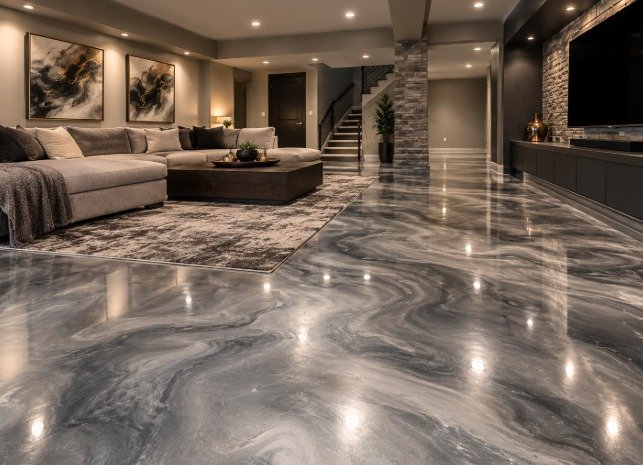
Basement Epoxy Flooring
Basement epoxy flooring can transform unfinished concrete into a cleaner and more usable surface.
Epoxy is often chosen for:
Finished basements
Recreation rooms
Storage areas
Home gyms
Workshops
Utility rooms
Laundry spaces
Hobby rooms
Basement floors should be evaluated for moisture before installation because below-grade concrete can sometimes experience vapor transmission.
When conditions are appropriate and the floor is prepared correctly, epoxy can provide a durable and attractive basement flooring solution.
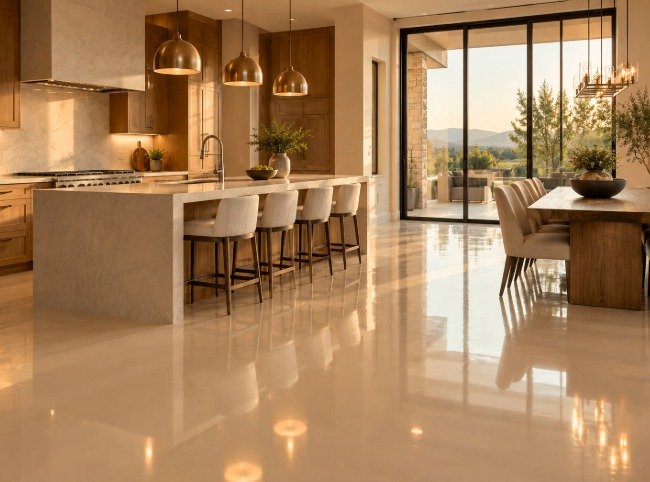
Kitchen Epoxy Flooring
Epoxy flooring can also be used in certain residential kitchens, especially homes with concrete slab floors.
A seamless epoxy surface can create a modern appearance and is available in decorative designs that resemble stone, marble, or polished concrete.
Kitchen epoxy flooring can be customized with:
Metallic effects
Solid colors
Marble-style patterns
Decorative chips
Satin finishes
High-gloss finishes
Because kitchens experience frequent spills and foot traffic, the coating system should be selected with durability and maintenance in mind.
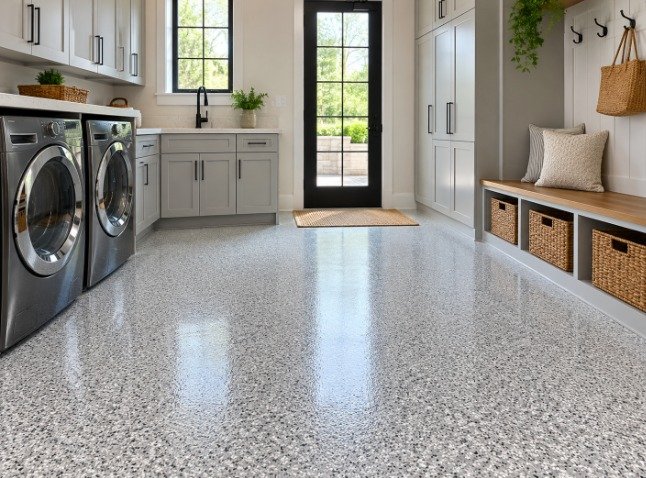
Laundry Room Epoxy Flooring
Laundry rooms are exposed to water, detergent, appliances, and regular foot traffic. Epoxy flooring can provide a clean, seamless surface that is easier to maintain than unfinished concrete.
A properly installed floor may also help improve resistance to common household spills and stains. Slip-resistant additives can be incorporated when additional traction is desired.
Mudroom Epoxy Flooring
Mudrooms are high-traffic areas where dirt, water, and outdoor debris frequently enter the home. Epoxy flooring can be a practical choice for concrete mudroom floors because the surface can be cleaned easily and customized to match the home.
Decorative flake systems can be especially useful because their multi-color appearance can help disguise small amounts of dirt between cleanings.
Garage Epoxy Flooring
Garage floors are one of the most popular residential applications for epoxy.
Bare garage concrete can become stained by oil, dirty from tire traffic, dusty, cracked, and difficult to maintain. Epoxy flooring creates a more finished surface that is easier to sweep, wash, and keep organized.
Homeowners can choose from decorative flake systems, solid colors, metallic finishes, anti-slip surfaces, and high-performance topcoats.
Garage epoxy can be installed in one-car, two-car, three-car, and oversized residential garages.
Home gyms need flooring that can handle repeated use, exercise equipment, benches, weights, and foot traffic. Epoxy can create a strong base surface for home fitness areas.
Depending on the layout, homeowners may choose to use epoxy alone or combine it with rubber mats in areas where heavy weights are dropped. A decorative epoxy floor can also make a home gym look more professional and organized.
Popular options include:
Gray epoxy
Black epoxy
Flake systems
Matte finishes
Anti-slip textures
Metallic designs
Workshop Epoxy Flooring
Residential workshops often deal with tools, equipment, sawdust, oils, adhesives, paints, and other materials. Epoxy flooring can help create a cleaner and easier-to-maintain work area.
Workshop systems can be designed with increased durability, chemical resistance, and slip resistance depending on how the space is used.
A properly coated floor can also make it easier to locate dropped hardware and clean up dust or debris.
Entryway Epoxy Flooring
Concrete entryways, enclosed porches, and similar transitional spaces can benefit from decorative epoxy flooring.
These areas experience regular foot traffic and may also be exposed to dirt and moisture from outside.
Epoxy can provide a clean, customized appearance while making routine maintenance easier.
Interior Concrete Epoxy Floors
Epoxy is increasingly used as a decorative finish for interior concrete floors. Modern metallic and decorative systems can create unique flooring designs for living areas, studios, offices, game rooms, and other spaces.
Interior epoxy flooring can be designed to imitate:
Marble
Natural stone
Polished concrete
Granite
Abstract metallic patterns
Because the pattern is created during installation, decorative epoxy floors can have a highly customized appearance.
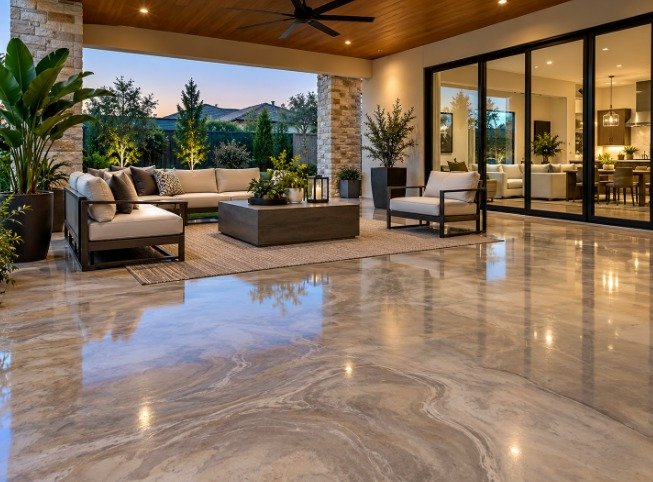
Patio Epoxy Flooring
Some exterior or covered concrete patios can be coated with systems designed for the specific conditions of the area. Patio floors may require coatings with UV resistance, slip resistance, and weather durability.
Not every indoor epoxy system is appropriate for exterior use, so the coating should always be selected according to the environment.
Residential patio coating options may include:
Decorative flake systems
Textured coatings
Solid colors
Stone-look finishes
Slip-resistant surfaces
Pool Deck Epoxy Flooring
Pool areas require special attention because the surface is frequently exposed to water and direct sunlight. A traditional indoor epoxy may not be the best system for every pool deck. Exterior coating systems designed for UV exposure and wet conditions may be more appropriate.
Slip resistance is especially important around swimming pools. A professionally selected coating can improve both the appearance and usability of the area while providing a more finished look than bare concrete.
Decorative Flake Epoxy Flooring
Flake epoxy is one of the most popular residential coating systems. Decorative vinyl chips are broadcast into the coating and then sealed with a protective topcoat. Flake systems provide visual texture and are available in many color blends.
Common combinations include:
Gray and black
Gray and white
Tan and brown
Blue and gray
Black and white
Custom color blends
Flake floors are commonly used in garages, workshops, utility rooms, basements, and other residential spaces.
Metallic epoxy is designed for homeowners who want a more decorative and distinctive floor. Metallic pigments are blended into the coating to create movement, depth, and swirling patterns. The appearance can resemble marble, stone, smoke, waves, or abstract art.
Popular metallic colors include:
Silver
Charcoal
Copper
Bronze
Blue
Black
White
Gold
Because each metallic floor is created by hand, the final pattern is unique.
Solid-color epoxy provides a clean and simple appearance. This style works well in residential areas where the homeowner wants a uniform surface without decorative flakes or metallic effects.
Popular residential colors include gray, tan, beige, white, charcoal, blue, and black.
Solid-color systems can be finished with different gloss levels depending on the desired look.
Custom Colors and Finishes
Residential epoxy flooring can be customized to match the home and the homeowner’s style. Options may include:
Solid colors
Decorative flakes
Metallic finishes
Marble effects
Gloss finishes
Satin finishes
Matte finishes
Textured surfaces
Custom color combinations
The design possibilities make epoxy suitable for both simple utility spaces and decorative interior applications.
Some areas of the home require additional traction. Anti-slip additives can be incorporated into the coating system to create a more textured surface.
Slip-resistant residential epoxy may be useful in:
Garages
Laundry rooms
Entryways
Workshops
Pool areas
Covered patios
Utility rooms
The amount of texture can be adjusted based on the location and intended use.
Our Residential Epoxy Flooring Process
1
Free In-Home Estimate
We walk through each area with you, measure the space, discuss how every room is used and show color, flake and metallic samples.
2
Concrete Inspection & Moisture Evaluation
We check the slab for cracks, old coatings and contamination, and test for moisture, especially in basements and older homes.
3
Room Protection & Setup
We protect walls, cabinets, doors and nearby rooms, and set up dust-controlled equipment to keep your home clean.
4
Grinding & Surface Preparation
The concrete is diamond-ground to remove contaminants and create the profile the coating needs to bond.
5
Crack, Joint & Surface Repair
Cracks, chips, spalling, old patches and uneven areas are repaired and ground smooth.
6
Primer & Base Coat
A primer (moisture-mitigating when needed) and a base coat are applied for a strong, lasting bond.
7
Flakes, Metallic or Color & Topcoat
We add your decorative flakes, metallic design or solid color, then seal it with a protective topcoat in your chosen gloss and texture.
8
Cure Time & Final Walkthrough
We review the finished floor with you, explain when each room can be used and share simple care instructions.
Concrete Surface Preparation
Proper preparation is essential for residential epoxy flooring. Professional preparation may include mechanical grinding, cleaning, crack repair, and surface profiling.
This process helps remove contaminants and creates a surface that allows the coating to bond properly.
Skipping surface preparation can lead to peeling, bubbling, or premature coating failure.
Concrete naturally contains moisture, and some slabs may have higher vapor transmission than others. This is especially important in basements, garages, and older homes.
Moisture testing may be recommended before installation.
Depending on the conditions, a moisture-mitigating primer or another flooring system may be necessary.
Epoxy Floor Repair
Existing concrete should be repaired before coating whenever necessary.
Common problems include:
Cracks
Chips
Surface deterioration
Spalling
Previous patchwork
Damaged joints
Uneven areas
Repairs help create a smoother and more stable surface for the new flooring system.
Concrete naturally expands and contracts, so some movement may still occur over time. However, proper repair and preparation can significantly improve the finished result.
Epoxy Floor Resurfacing
Older residential concrete may require resurfacing before it can be coated.
Resurfacing can involve grinding away damaged material, repairing weak areas, and creating a uniform surface.
This is especially useful for older garage floors, basements, workshops, and utility areas.
The goal is to create a suitable foundation for the coating system rather than simply covering existing damage.
Residential Epoxy Flooring Cost in Los Angeles
Residential epoxy flooring is priced by square foot, the coating system and the condition of the concrete. The ranges below are typical for Los Angeles homes and include standard surface preparation.
Typical cost by space
Space
Approx. area
Estimated cost
Laundry Room / Mudroom
60 – 150 sq. ft.
$750 – $1,600
Home Gym / Workshop
200 – 400 sq. ft.
$1,200 – $3,600
2-Car Garage
about 450 sq. ft.
$2,300 – $4,000
Basement
600 – 1,000 sq. ft.
$3,000 – $9,000
Covered Patio
200 – 500 sq. ft.
$1,400 – $5,000
Price by coating system
System
Per sq. ft.
Solid Color Epoxy
$4 – $7
Decorative Flake
$5 – $9
Exterior / Polyaspartic
$7 – $12
Metallic / Marble Look
$8 – $14
What Affects the Price
Size and number of rooms
Condition of the concrete
Crack and surface repairs
Removal of old coatings or flooring
Moisture mitigation if needed
Indoor or outdoor (UV) system
Flake, metallic or custom design
Anti-slip texture and gloss level
Prices are estimates only. Small rooms may have a minimum project charge, and your final price depends on floor size, concrete condition, repairs needed and the finish you choose. Every home gets a free estimate and a written quote before work begins.
Residential epoxy flooring offers several practical and aesthetic benefits. These can include:
Cleaner appearance
Easier maintenance
Reduced concrete dust
Improved stain resistance
Decorative customization
Seamless surface
Multiple finish options
Improved durability
Better protection for concrete
Slip-resistant options
The exact performance depends on the coating system, surface preparation, and installation quality.
Easy-to-Clean Residential Flooring
One of the biggest advantages of residential epoxy is easier maintenance. Unlike unfinished concrete, epoxy does not produce concrete dust and is less porous.
Routine cleaning may include:
Sweeping
Vacuuming
Dust mopping
Damp mopping
Washing with suitable cleaners
Spills should be cleaned promptly, especially oils, chemicals, or strongly pigmented materials.
Residential Epoxy Flooring Maintenance
Maintaining epoxy flooring is generally straightforward.
Keep the floor free of abrasive dirt and sand, wipe spills quickly, and use appropriate cleaning products.
Avoid dragging sharp metal objects across the surface.
Protective pads can be used under heavy equipment, storage cabinets, and workbenches where needed.
Regular cleaning helps keep the floor looking fresh and can extend the life of the coating.
Epoxy can be installed over most concrete floors in a home, including garages, basements, laundry rooms, mudrooms, home gyms, workshops, kitchens on slab foundations, living areas and covered patios. It is not installed over wood subfloors or carpet. During your free estimate we inspect each area, check the concrete and recommend the right indoor or outdoor coating system for how the space will be used.
Yes. We use low-VOC and zero-VOC coating systems that release far fewer fumes than traditional products, and once fully cured, epoxy is inert and safe for everyday living. The seamless surface does not trap dust, pet hair or allergens the way grout lines and carpet can. We recommend keeping kids and pets off the floor during installation and curing, and we'll tell you exactly when each area is ready to use.
Sometimes. Below-grade concrete can have moisture vapor coming through the slab, which can cause coatings to bubble or peel if it isn't addressed. We test the basement floor before installation. Depending on the results, we may use a moisture-mitigating primer or recommend a different system. If a basement has active leaks or standing water, those problems need to be fixed first so the new floor can perform as expected.
Most residential rooms are finished in one to three days, depending on size, repairs and the finish. Decorative metallic floors may take an extra day. Light foot traffic is usually allowed after about 24 hours, furniture can often return after 48 to 72 hours, and vehicles can park on garage floors after about 72 hours. We'll plan the schedule with you so your home stays as usable as possible.
A smooth, high-gloss epoxy floor can become slick when wet, just like tile or polished stone. For kitchens, laundry rooms, mudrooms and entryways, we can add a fine anti-slip additive to the topcoat, choose a satin finish or use a flake system that naturally provides more grip. The amount of texture is adjusted so the floor has good traction while staying easy to mop and clean.
Upgrade Your Home with Residential Epoxy Flooring
Residential epoxy flooring can turn plain or worn concrete into a clean, durable, and visually appealing surface.
Whether you are updating a garage, finishing a basement, improving a workshop, creating a home gym, or adding a decorative finish to an interior concrete floor, there are epoxy systems available for many different residential applications.
From solid-color coatings and decorative flakes to metallic designs and slip-resistant finishes, each floor can be customized to fit the space and the homeowner’s goals.
With proper preparation, quality materials, and professional installation, residential epoxy flooring can provide a long-lasting upgrade that improves both the appearance and usability of your home.